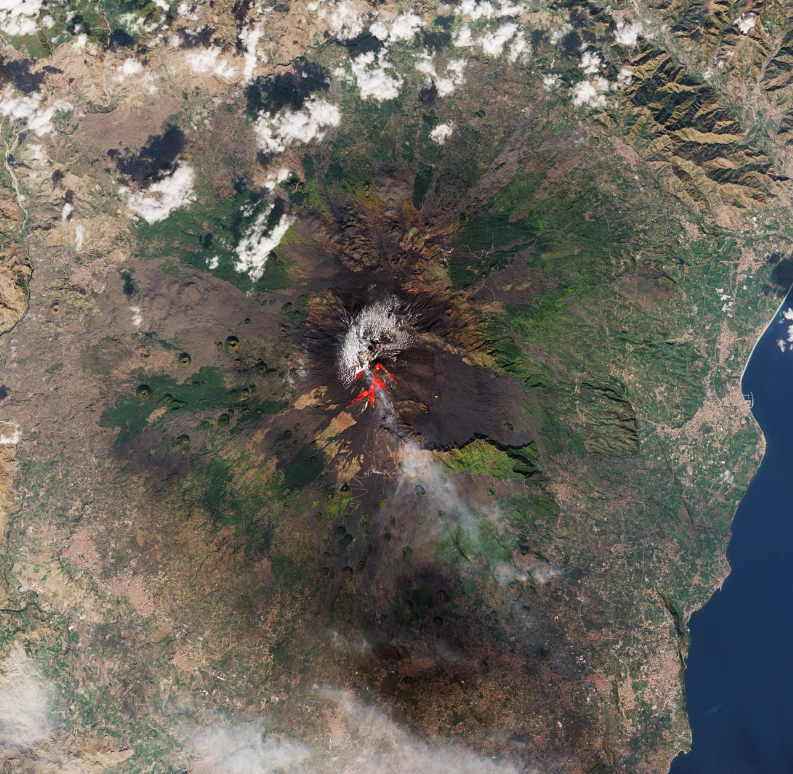
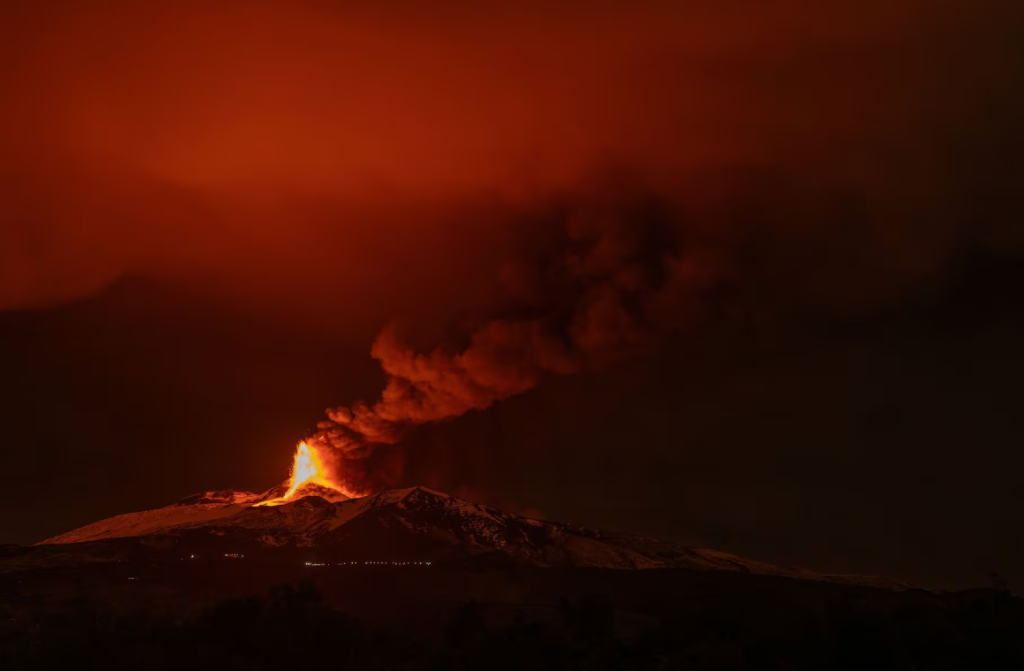
Mount Etna on the Italian island of Sicily erupted at dawn on Friday, creating a festive spectacle of fire and ice.
At 3,3057 metres, it’s Europe’s tallest volcano and has been constantly active in the past ten years.
But no one has been injured and no one is in danger.
Volcanologists have described the activity on Etna in recent days as a succession of Strombolian eruptions – which are moderately explosive but short eruptions named after the volcano on the nearby island of Stromboli.

00:44
Mount Etna eruption lights up the night sky
Close
Italy’s Mount Etna is erupting again, sending hot lava down its slopes and illuminating the night sky.
Located on the Italian island of Sicily, Etna is Europe’s most active volcano, though its outbursts rarely cause significant damag.
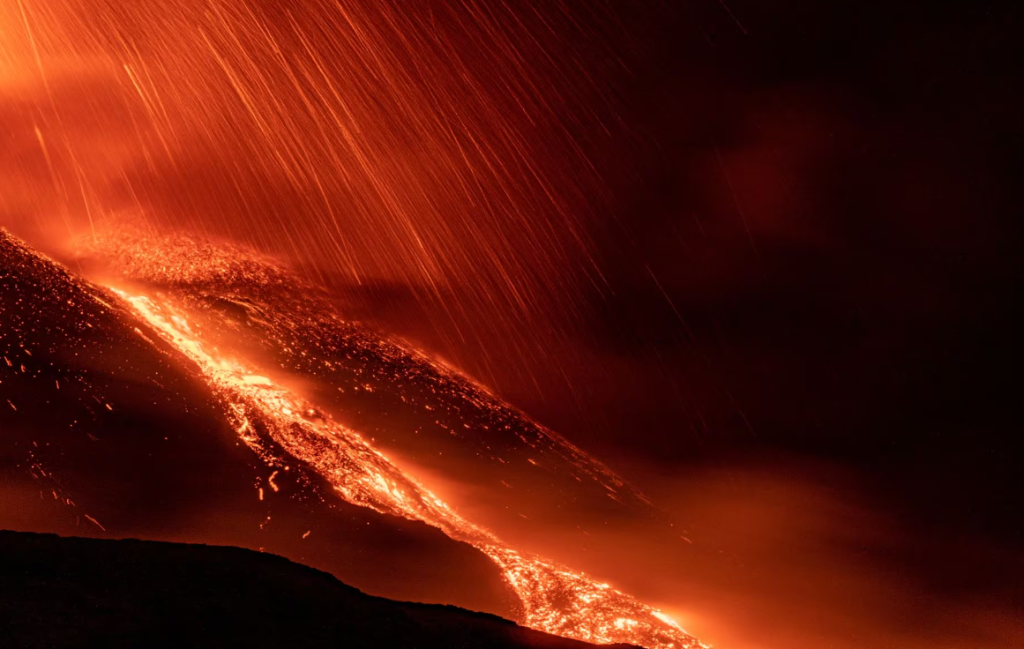
Geological Summary. Mount Etna, towering above Catania on the island of Sicily, has one of the world’s longest documented records of volcanism, dating back to 1500 BCE. Historical lava flows of basaltic composition cover much of the surface of this massive volcano, whose edifice is the highest and most voluminous in Italy. The Mongibello stratovolcano, truncated by several small calderas, was constructed during the late Pleistocene and Holocene over an older shield volcano. The most prominent morphological feature of Etna is the Valle del Bove, a 5 x 10 km caldera open to the east. Two styles of eruptive activity typically occur, sometimes simultaneously. Persistent explosive eruptions, sometimes with minor lava emissions, take place from one or more summit craters. Flank vents, typically with higher effusion rates, are less frequently active and originate from fissures that open progressively downward from near the summit (usually accompanied by Strombolian eruptions at the upper end). Cinder cones are commonly constructed over the vents of lower-flank lava flows. Lava flows extend to the foot of the volcano on all sides and have reached the sea over a broad area on the SE flank.