The world’s most famous Christmas tree has arrived in Manhattan. A 23-metre Norway spruce, planted more than 50 years ago by a local father, has begun its journey towards becoming the centrepiece of New York’s Christmas celebrations.
The world’s most famous Christmas tree has arrived at Rockefeller Center in New York City. On Thursday, November 5, a crane and a team of workers cut down a 23-metre-tall Norway spruce, measuring 15 metres across and weighing approximately 10 tonnes, in West Edmeston, a small village of around 1,300 residents in upstate New York.
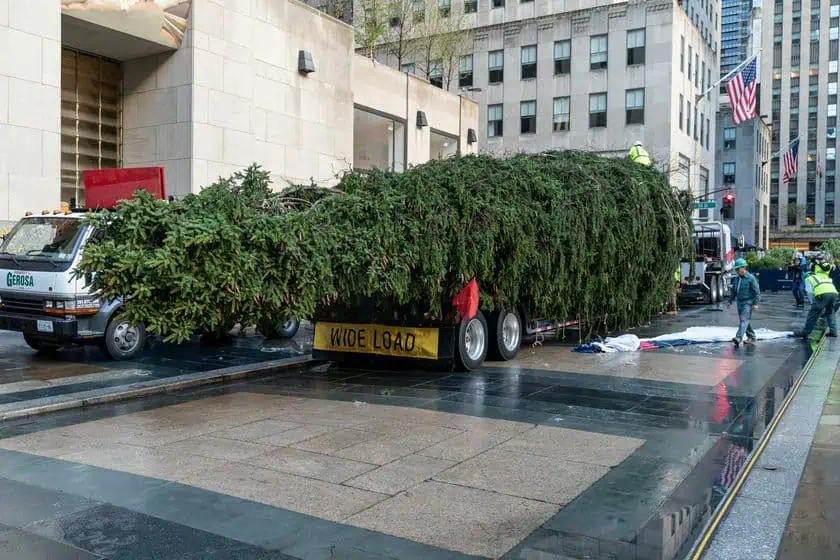
From there, the enormous tree began its journey towards America’s largest city. After travelling approximately 320 kilometres by road, it finally reached Rockefeller Plaza, where crowds had gathered to witness its arrival.
But this is no ordinary Christmas tree, nor does it come from a forest. It was planted more than 50 years ago by a local father, who passed away on Christmas Eve ten years ago. Behind its journey lies a complex logistical operation involving specially designed trailers, police escorts, steel pins and cables secured to nearby skyscrapers.
Here is everything we know about the 2026 Rockefeller Center Christmas Tree and its journey to Manhattan.
The 2026 Christmas Tree in Numbers
Standing just over 23 metres tall, this year’s tree is slightly taller than its 2025 predecessor, which measured approximately 22.8 metres. It is also considerably wider, with a diameter of 15 metres compared with last year’s 14 metres.
Weighing around 10 tonnes, the giant spruce will become the centrepiece of New York’s festive season.
From Preparation to Decoration: How the Tree Is Made Ready
Preparing the Rockefeller Center Christmas Tree begins months before it is cut down, while it is still growing on the donor’s property.
Erik Pauzé, head gardener at Rockefeller Center, personally oversees every stage of the process.
- Care and watering. Pauzé regularly visits the property to feed and water the tree. During the particularly hot summer of 2025, for example, he travelled to East Greenbush once a week, bringing between 3,000 and 3,800 litres of water mixed with compost tea.
- Measurements and anchor points. Workers repeatedly climb the tree to take measurements and identify the points on the trunk where support cables will eventually be attached in Manhattan. Reinforcements are installed on the trunk to serve as anchor points during installation.
- Wildlife checks. During these inspections, workers also check that no animals are living among the branches. However, the discovery of a little owl nicknamed Rocky in the tree in 2020 proved that these checks are not always foolproof.
- Tying the branches. For approximately six days before the tree is cut down, its branches are carefully tied and pulled towards the trunk using ropes. This creates a compact shape that allows the tree to be transported without damaging its branches.
- Setting up the worksite. A day or two before the operation, the crane arrives. Workers place supporting plates on the ground, install counterweights and attach the crane to the tree.
Once everything is ready, the cutting operation begins. While the crane supports the enormous spruce, workers use chainsaws to cut through the trunk at its base.
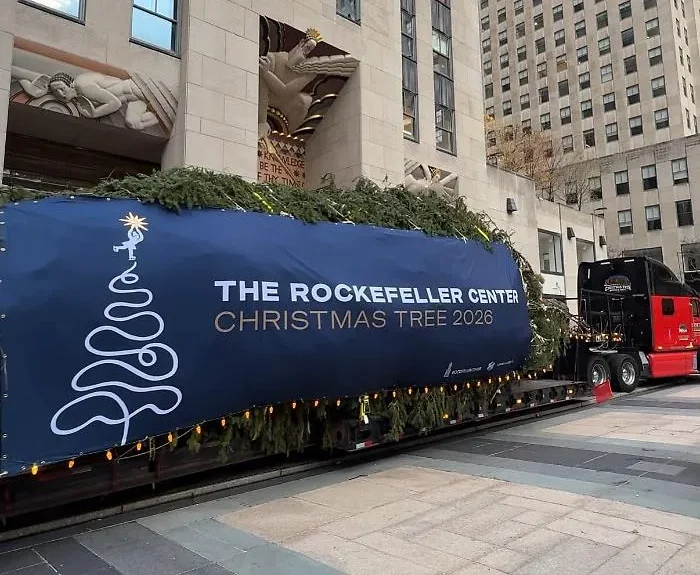
The tree is then carefully lowered onto a flatbed trailer and secured with heavy-duty straps. The trailer is a specially designed telescopic model capable of transporting trees up to 38 metres tall. However, the real limitation is Manhattan itself: the streets surrounding Rockefeller Center are so narrow that trees cannot exceed 30 metres in height.
Large Rockefeller Center banners are then attached to both sides of the tree before the convoy sets off.
A 320-Kilometre Journey to Manhattan
The journey takes approximately two days. Although the 320-kilometre distance could be covered in less than four hours by car, transporting a 10-tonne tree requires a much slower and more carefully coordinated operation.
The convoy travels under police escort, with some roads temporarily closed along the route.
Pauzé does not simply follow the operation from a distance: he travels in the passenger seat of the truck, acting as expedition leader throughout the journey.
The route changes every year depending on where the tree comes from and which roads are affected by construction work. Previous routes have included the George Washington Bridge, the Hudson River crossing formerly known as the Tappan Zee Bridge, and Interstate 95 through Connecticut.
The final approach is the most delicate part of the journey. The truck travels south along one of Manhattan’s wider avenues before turning onto 49th Street and entering Rockefeller Plaza.
Given the size and weight of the cargo, it is certainly no ordinary delivery.
Raising the Tree: A Delicate Engineering Operation
Once the tree arrives, it must be raised into position in front of the waiting public. In many ways, the process is the reverse of cutting it down.
The installation involves several carefully coordinated stages, as explained by Pauzé.
- Lifting the tree horizontally. A crane lifts the spruce off the trailer and holds it horizontally, a few metres above the ground.
- The steel pin. Workers drill a hole into the base of the trunk and insert a large steel pin, estimated by observers of previous installations to be approximately 60 centimetres long.
- Turning the tree upright. The crane slowly rotates the tree into a vertical position. Workers cut many of the ropes holding the branches together, allowing them to gradually spread out again.
- Securing the base. The steel pin is guided into the centre of the tree’s metal base, where it locks into steel supports designed to prevent the trunk from moving.
- Four support cables. At approximately halfway up the tree, four cables are attached to the reinforced anchor points installed on the trunk months earlier. According to those who have followed previous installations, two cables are secured to 30 Rockefeller Plaza, while the other two are attached on the opposite side of the skating rink.
- Final adjustments. The tension of the cables is carefully adjusted until the tree stands perfectly straight.
Once installed, the spruce needs a considerable amount of water. During its first few days in Rockefeller Plaza, it can absorb approximately 340 litres, although its daily consumption gradually decreases over time.
Watering is carried out by one of Rockefeller Center’s gardeners using a simple garden hose.
Three Weeks of Preparation: Scaffolding, Lights and the Star
There are 25 days between the tree’s arrival and the official lighting ceremony. During this period, workers install scaffolding, thousands of lights and the famous Swarovski star.
From November 7 until December 2, the tree remains surrounded by several levels of scaffolding, allowing workers to reach every section of its enormous branches.
Visitors to Rockefeller Plaza will therefore see the tree surrounded by scaffolding until the evening of the lighting ceremony.
Interestingly, not all the branches visible on the finished tree originally belong to it. Additional branches, known as camouflage branches, are added to cover cables and wires and create a fuller, more uniform appearance.
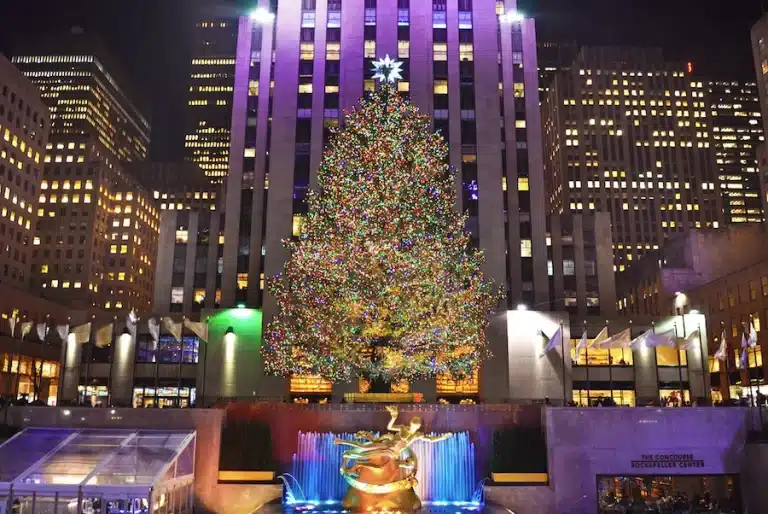
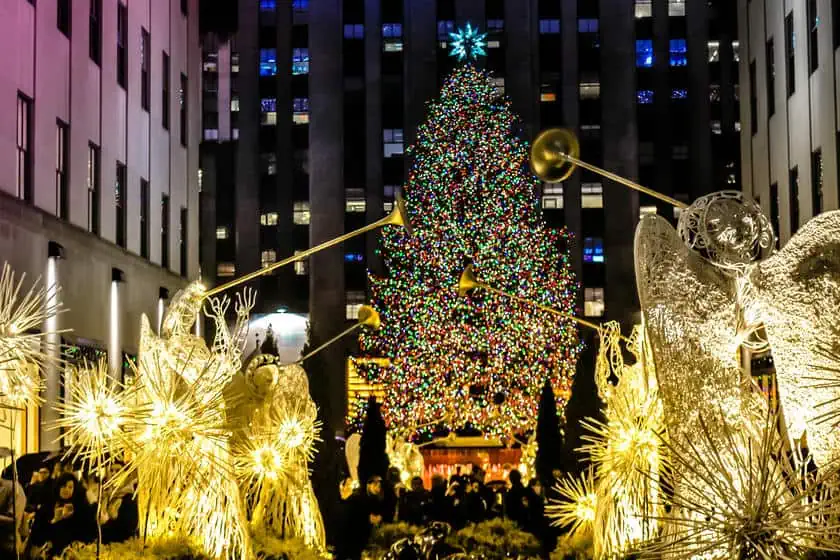
More than 50,000 multicoloured LED lights will illuminate the tree, connected by approximately eight kilometres of electrical cable.
One little-known detail is that the lights are not reused from one year to the next. Instead, a completely new set is installed every season. In recent years, some bulbs from previous trees have been transformed into Christmas decorations for the following year’s celebrations.
The lights are switched on automatically using a timer controlled by a panel in the underground levels of Rockefeller Center.
Since the introduction of LED lighting in 2007, the tree’s energy consumption has fallen significantly, from 3,510 to 1,297 kilowatt-hours per day.
The famous Swarovski star, meanwhile, does not actually rest on top of the tree, as its weight of 408 kilograms would be too much for the branches to support.
Instead, a crane lowers a steel tube into the centre of the tree’s crown. The tube is secured to the trunk using wooden wedges, before the same crane lifts the star and carefully places it inside.
Once the Christmas season is over, the star and the illuminated angels from the Channel Gardens are returned to a climate-controlled warehouse, where they remain until the following year.
The Heartwarming Story Behind the 2026 Tree
Beyond its impressive size and elaborate installation, this year’s tree has a particularly touching story.
The 2026 Norway spruce was planted around 1970 by Carl Camenga, a local builder, outside the house he had recently built with his own hands in West Edmeston.
The small rural community lies along the Unadilla River, between Madison and Otsego counties, approximately 45 kilometres south of Utica and about a 30-minute drive from Cooperstown, home of the Baseball Hall of Fame.
Carl planted the tree in the early 1970s together with his son Wade, who still remembers bringing it home and planting it alongside his father.
The four Camenga children – Wade, Lash, Gloria and Alesia – grew up in the family home along State Route 8, watching the little spruce grow year after year until it became a familiar landmark on their property.
There is one detail that makes the story even more emotional.
Carl Camenga passed away on Christmas Eve 2016. Christmas had always been his favourite time of the year, and this season marks the tenth anniversary of his death.
His children have said that their father would have been delighted to know that the wood from his beloved tree will eventually help build homes for families in need.
This is part of the Rockefeller Center Christmas Tree tradition: after the holiday season, the tree is donated to Habitat for Humanity, where its timber is used in the construction of homes for people who need them.
In this way, the tree’s story does not end when Christmas is over. Instead, it takes on a new purpose, bringing hope and support to families long after the decorations have been taken down.
When Will the Rockefeller Center Christmas Tree Be Lit?
The official lighting ceremony will take place on December 2, 2026, beginning at 7 p.m. and ending at 10 p.m.
The annual event attracts thousands of visitors to Rockefeller Plaza and millions of viewers watching from home.
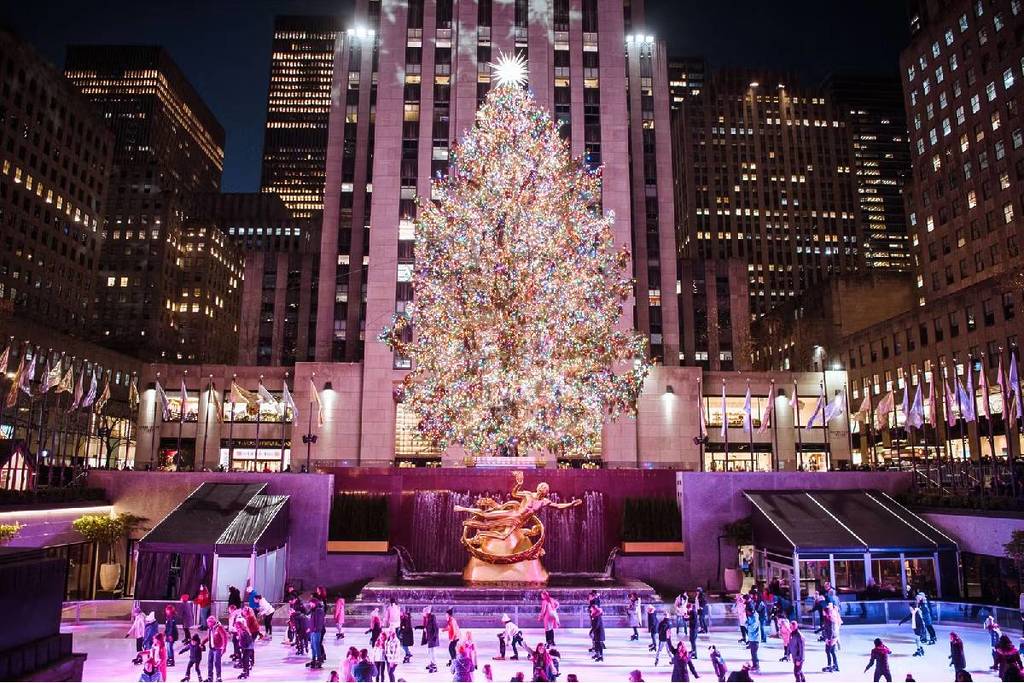
Beneath the towering Christmas tree, visitors can also enjoy one of New York’s most iconic winter traditions: ice skating at The Rink, Rockefeller Center’s famous outdoor skating rink.
For New Yorkers and visitors from around the world, the arrival of the tree marks the beginning of the Christmas season in the city.
And for the Camenga family, this year’s celebration carries an even deeper meaning: a tree planted by a father more than half a century ago will now become a symbol of Christmas for millions of people, while continuing to make a difference in the lives of others.