
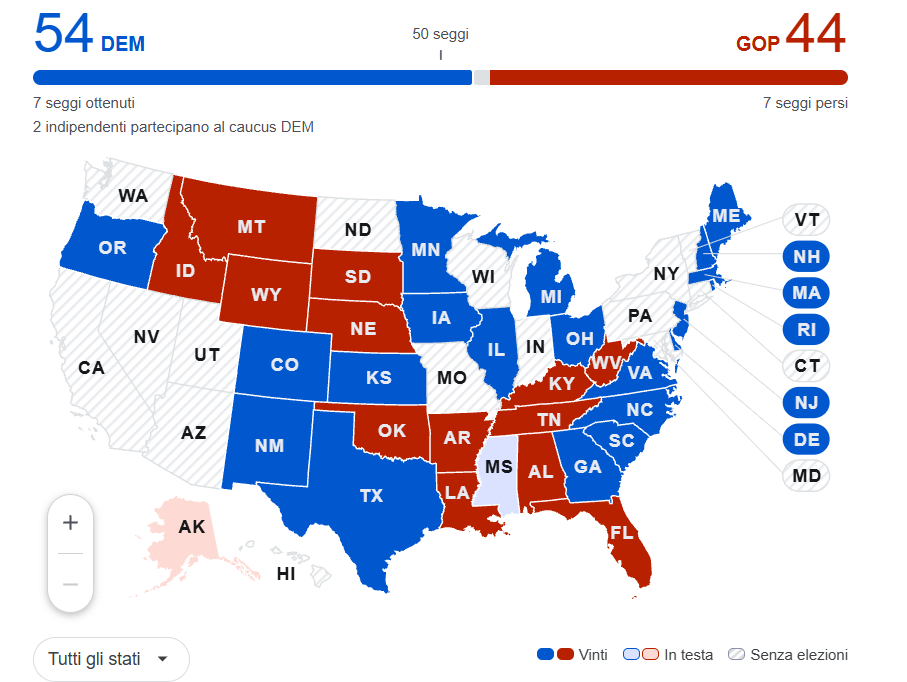
Democrats have secured a majority in the House of Representatives, reaching the crucial 218-seat threshold, while also taking control of the Senate with a 53–40 lead. A sweeping victory that leaves Donald Trump politically weakened and facing a divided final two years in office.
What Donald Trump had feared as a “blue wave” has turned into what Americans might call a “blue tsunami” – a political blue-nami that the former businessman and current president has been unable to resist.
Although several states are still counting their ballots following the 2026 Midterm Elections, the overall picture is already clear: the first two years of Trump’s presidency have been decisively rejected by voters across the country, including in traditionally solid Republican strongholds.
From the heart of the Midwest, in Iowa and Kansas, to North and South Carolina, passing through industrial Ohio, Maine and the Lone Star State of Texas, several states that had long served as the backbone of the MAGA movement have shifted away from Republicans in key Senate races.
In the House of Representatives, more than twenty congressional districts have already changed political allegiance, turning from red to blue.
The result is a major political setback for Trump. Democrats have secured control of both chambers of Congress, leaving the president increasingly isolated on Capitol Hill and significantly limiting his ability to advance his legislative agenda.
Trump now faces the prospect of becoming a political lame duck: a president whose influence and political authority have been substantially weakened by the loss of congressional support.
Obama: “The American people have sent a clear message”
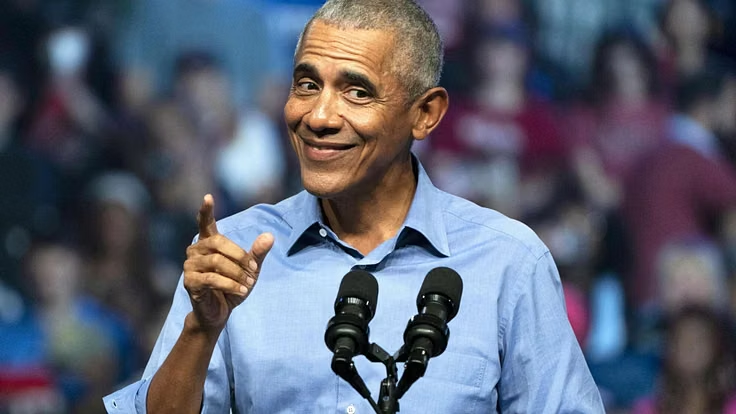
Former President Barack Obama was among the first prominent Democrats to comment on the election results.
“Tonight, the American people sent a clear message: they want a politics that brings people together rather than divides them, and leaders who offer concrete solutions to the challenges they face,” Obama wrote on X.
He credited the victory to the work of outstanding Democratic candidates across the country, including in traditionally difficult-to-win areas.
“These results were possible only because exceptional candidates stepped forward in every region of the country. They came from different backgrounds and represented a range of political perspectives, but they were united by shared values, a belief in public service and a commitment to putting the people of their districts and states first.”
Obama also thanked the thousands of election officials and volunteers from both parties who helped ensure the smooth running of the electoral process.
Looking ahead, he called on Democrats to make the most of their newly gained political power.
“Although this administration still has two years left in office, our task now is to roll up our sleeves, make changes wherever we have the power to do so, prevent further damage and lay the groundwork for the future,” he added.
Trump becomes a “lame duck”: What does it mean and what powers does he retain?
Despite the Democrats’ victory, Donald Trump will remain president until January 20, 2029. However, the new balance of power in Congress could make governing considerably more difficult.
The expression lame duck refers to a political leader whose authority has been weakened, often because of an electoral defeat or because their time in office is coming to an end.
The term has an interesting historical background. It originated in 18th-century England, where it was used in financial circles to describe stockbrokers who were unable to meet their financial obligations. The image was that of an injured duck struggling to walk and therefore particularly vulnerable.
The expression later entered American political vocabulary. According to the historical account published by the US House of Representatives, it became part of political language in the 1830s, initially referring to politicians who had lost an election or were approaching the end of their terms.
In Trump’s case, the loss of both chambers of Congress means that his ability to pass new legislation will be severely constrained.
Nevertheless, the president will retain important constitutional powers. He can continue to issue executive orders, provided they remain within the limits of the law, and exercise his veto over legislation passed by Congress.
The Democrats’ victory therefore does not bring Trump’s presidency to an end, but it marks a significant turning point. With Congress now under Democratic control, the final two years of his administration could become a period of political confrontation, legislative gridlock and growing pressure on the White House.