
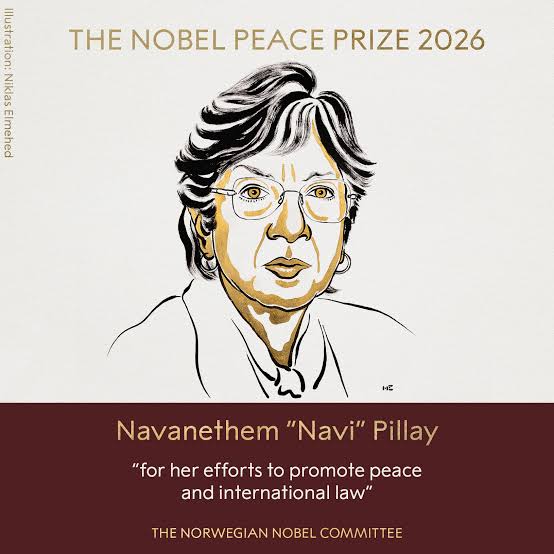
The South African jurist, who has held leading positions in international courts, accused Israel of committing genocide in Gaza. Israeli Prime Minister Benjamin Netanyahu responded furiously, accusing her of “demonising Jews”.
The 2026 Nobel Peace Prize has been awarded to an international jurist at a time “when international law and its institutions are under attack”. By honouring Navanethem “Navi” Pillay, a South African lawyer who rose from the struggle against apartheid to the highest ranks of international justice, the Norwegian Nobel Committee has sent a clear message: war crimes, crimes against humanity and genocide must be prosecuted.
Throughout her distinguished career, Pillay has served in some of the most important international judicial institutions, including the International Criminal Tribunal for Rwanda and the International Criminal Court (ICC).
Although Nobel Committee chairman Jørgen Watne Frydnes stressed that the decision was not directly linked to the war in Gaza, one of Pillay’s most recent assignments placed her at the centre of the international debate over the conflict. A year ago, the 85-year-old jurist chaired the United Nations Independent International Commission of Inquiry on the Occupied Palestinian Territory, which accused Israel of committing genocide in the Gaza Strip.
Israeli Prime Minister Benjamin Netanyahu wasted no time in responding to the award, launching a fierce attack on the Nobel laureate. “Pillay demonises Jews,” he declared, accusing her of having “built a false case against Israel” to legitimise the actions of former ICC prosecutor Karim Khan, whom Netanyahu described as corrupt. Khan issued arrest warrants for the Israeli prime minister and former defence minister Yoav Gallant over alleged war crimes and crimes against humanity.
Israel’s Foreign Ministry also condemned the decision, calling it an endorsement of “the greatest lie of the 21st century” and adding that Joseph Goebbels, Adolf Hitler’s propaganda chief, would be “applauding from hell”.
US President Donald Trump also appeared to express his disapproval. Sharing a post on his Truth Social platform, he indirectly backed the criticism of Pillay, with the message describing the award as an “irreparable disgrace” and accusing the jurist of hating America and Israel. The episode also revived speculation over Trump’s frustration at once again being overlooked for the prize he has long coveted. Shortly afterwards, his administration imposed sanctions targeting the ICC.
None of these attacks, however, appeared to dampen Pillay’s joy. She learned of the award while attending an international law forum in Nuremberg, Germany, where she was visiting the historic courtroom in which leading Nazi officials were tried after the Second World War.
It was there, in Courtroom 600, that she held an impromptu press conference and dedicated her Nobel Peace Prize “to all the survivors of international crimes”.
She also addressed a direct appeal to political leaders and policymakers: “You have a legal obligation to protect human rights and to refrain from waging war.”
Asked about the courage she had supposedly shown in denouncing what the UN commission described as genocide in Gaza, Pillay appeared almost surprised by the question.
“Why would it take courage to tell the truth?” she asked. “You interpret the law, you examine all the facts, and then it is a process of impartial decision-making.”
Her remarks were captured on video by Agnès Callamard, secretary-general of Amnesty International, who also recorded a lighter moment in which Pillay joked about the possibility of sharing her prize with Trump.
“If you clap a little louder, perhaps I’ll share the prize with Trump,” she said, drawing laughter from the audience. The joke appeared to allude to Venezuelan opposition leader María Corina Machado, who presented her own Nobel Peace Prize medal to Trump following the US operation that led to the capture of Nicolás Maduro.
Beyond the criticism from Israel and the United States, Pillay received widespread recognition from international leaders. UN Secretary-General António Guterres and European Commission President Ursula von der Leyen were among those who praised her contribution to international justice, describing her as a defender of the rule of law against the law of force.
At a time when international institutions face mounting political pressure, Pillay’s award serves as a reminder of the principles underpinning the international legal order: accountability, the protection of human rights and the conviction that no state or political leader should stand above the law.