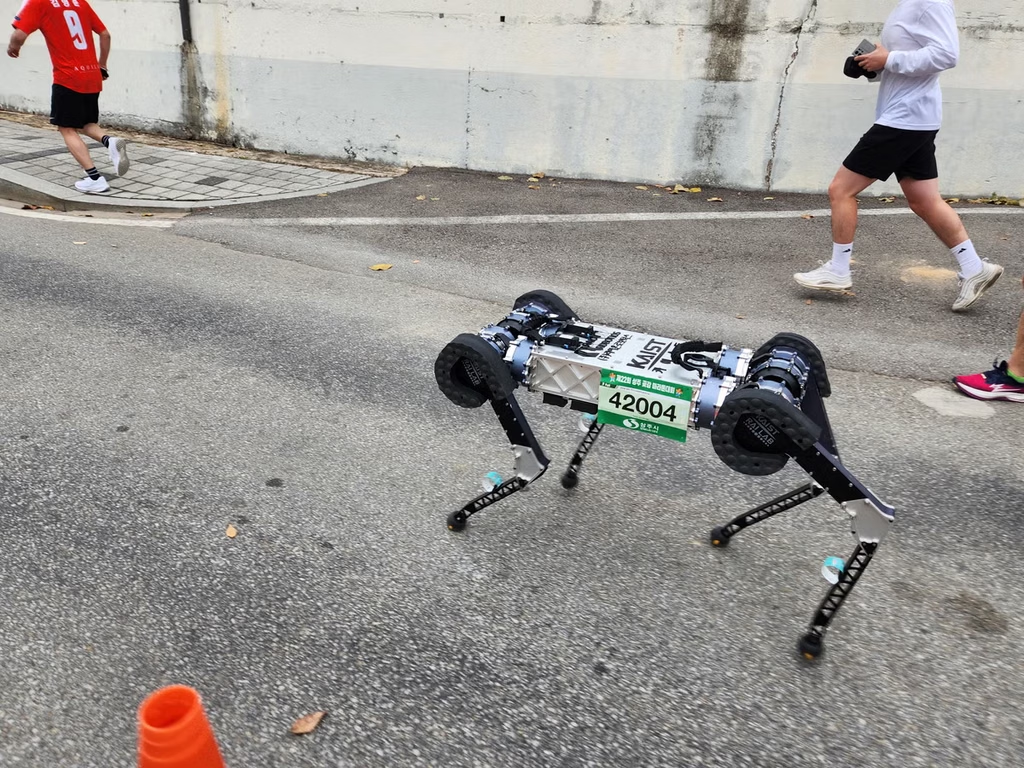
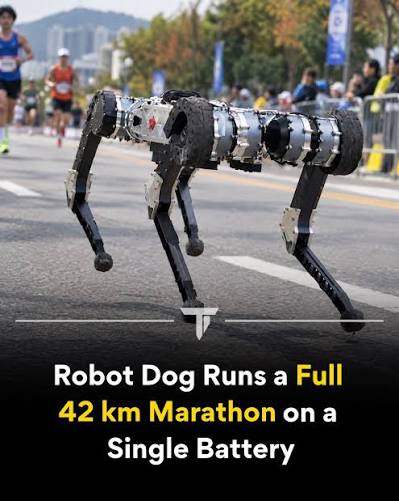
South Korean researchers have developed a highly energy-efficient quadruped robot that completed a 42-kilometre marathon in just 4 hours and 19 minutes, with enough battery power left to travel another 25 kilometres.
RAIBO2, a four-legged robot developed by scientists at the Korea Advanced Institute of Science and Technology (KAIST), has achieved a major milestone in robotic mobility by completing a full marathon on a single battery charge. The research team, led by Jemin Hwangbo, reported its findings in the journal Nature, highlighting a breakthrough in energy efficiency that could pave the way for robots capable of operating for extended periods in challenging real-world environments.
The robot successfully completed the Sangju Marathon in South Korea, covering 42 kilometres in 4 hours and 19 minutes at an average speed of 2.64 metres per second. Along the route, it navigated elevation changes of 286 metres and slippery terrain, demonstrating its ability to maintain performance under demanding conditions.
According to the researchers, RAIBO2’s performance is the result of a combination of hardware improvements and advanced software. The team incorporated ultra-lightweight legs, optimised motor drive circuits and machine-learning algorithms designed to refine the robot’s movement strategies and reduce energy consumption.
The results were impressive. RAIBO2 consumed just 1,280 watt-hours (Wh) of its total battery capacity of 2,016 Wh during the marathon. This left sufficient energy for an estimated additional 25 kilometres of travel, bringing its potential range on a single charge to approximately 67 kilometres.
The researchers also reported that RAIBO2 became the first quadruped robot to consume less energy than a human on a body-weight-adjusted basis, marking an important step forward in the development of energy-efficient robotic systems.
The implications extend well beyond endurance running. Robots with greater range and lower energy requirements could play a crucial role in search-and-rescue operations, particularly in mountainous areas, disaster zones and other environments where access is difficult and prolonged autonomous operation is essential.
Meanwhile, Japan is reportedly considering the use of AI-powered humanoid robots in defence-related support roles. According to government and ruling-party sources cited by the Kyodo news agency, the proposal is partly motivated by persistent difficulties in recruiting enough personnel for the country’s Self-Defense Forces.
Potential applications could include patrolling military bases and providing logistical support, rather than participating directly in combat. The initiative reflects a broader interest in using advanced robotics to address personnel shortages and improve operational efficiency.
As research into robotic mobility and physical artificial intelligence continues to advance, achievements such as RAIBO2’s marathon performance demonstrate how improvements in energy management, mechanical design and machine learning could expand the role of robots in demanding, real-world applications.