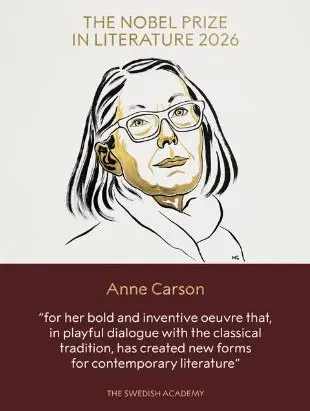
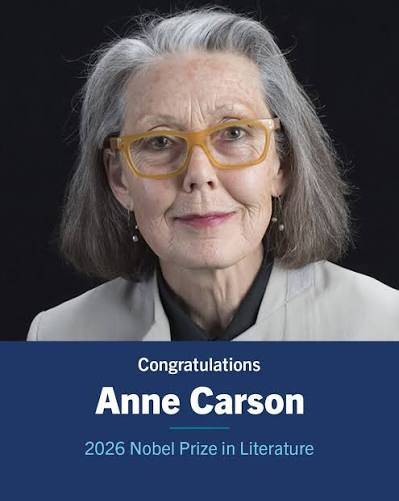
The 76-year-old Canadian writer is celebrated for her experimental style and her ability to bridge classical tradition and contemporary culture.
Canadian writer Anne Carson has been awarded the Nobel Prize in Literature in recognition of her bold and innovative contribution to contemporary literature. Known for her experimental approach and her ability to blend classical influences with modern themes, Carson has developed a distinctive literary voice that defies conventional genre boundaries.
The Swedish Academy praised her work for “creating new forms for contemporary literature through a playful dialogue with the classical tradition.”
Throughout much of her life, Carson has combined her literary career with academic pursuits. She has taught classics and comparative literature at several universities in Canada and the United States, while also working as a translator. Her academic background has played a significant role in shaping her writing, which frequently draws on ancient Greek and Roman literature.
Carson’s work is notoriously difficult to categorise. Moving freely between poetry, fiction, essays, visual arts and translation, she challenges traditional literary conventions and explores the boundaries between different forms of expression. Her writing is also deeply influenced by a wide range of authors, including Emily Brontë, Gertrude Stein, Simone Weil and Virginia Woolf, whose works she has cited as important sources of inspiration.
Despite her reputation as an ambitious and avant-garde writer, Carson has also demonstrated a keen interest in contemporary popular culture. In September, an extensive and passionate essay she wrote about Spanish singer Rosalía attracted considerable attention. Published in the London Review of Books, the piece highlighted Carson’s ability to engage with subjects far removed from the classical tradition that informs much of her work.
Even before the announcement, Carson had emerged as one of the most frequently discussed candidates in online literary circles. Debates on the World Literature Forum, one of the major international forums devoted to literature, had already placed her among the leading contenders for the prestigious award.
With this recognition, Carson’s unconventional and genre-defying body of work takes centre stage, underscoring the enduring relevance of classical literature and its capacity to inspire new forms of contemporary artistic expression.