
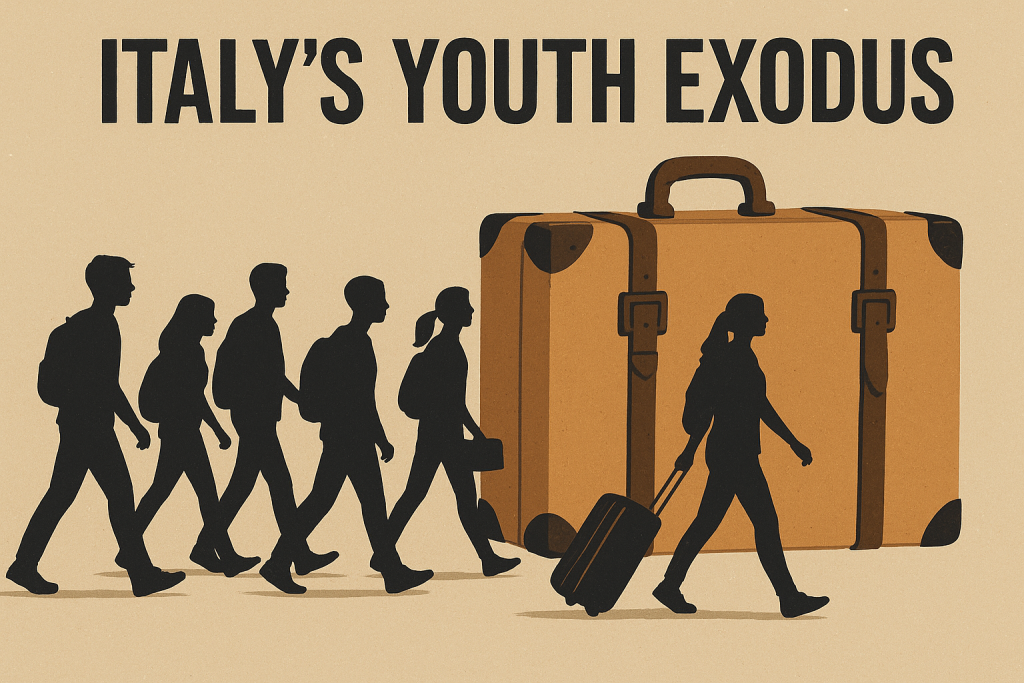
Over the past decade, Italy has quietly lost the equivalent of an entire city.
From 2014 to 2023, more than one million Italians packed their bags and left. Among them were 367,000 young people aged 25 to 34 — and nearly half were university graduates. That’s a whole generation of talent, educated in Italy, now contributing to other countries’ success stories.
According to the Nordest Foundation, 550,000 young Italians have left since 2011, and after counting those who returned, about 377,000 are still missing from the picture. The economic value of this “human capital” is staggering — around €134 billion. Most head to Germany, the UK, Switzerland, Spain, France, or the United States. The North of Italy has been hit hardest, but no region has been spared.
Behind the statistics are the reasons so many young people decide to leave. Italy’s economy has been moving in slow motion for decades. Since 2000, GDP has grown by just 9%, compared to 28% in Germany and 45% in Spain. Salaries, meanwhile, have barely budged. A young worker earns around €1,000 a month, while rent for a small apartment in Milan costs almost the same. Starting an independent life often feels impossible.
Why are they leaving?
Youth unemployment remains among the highest in Europe — one in five young Italians is without a job. Even for those who do find work, frustration runs deep: over a third of graduates end up in jobs that don’t require a degree. And climbing the social ladder is harder than ever — it can take five generations for a low-income family to reach the national average income.
Some policies, like tax breaks for Italians returning from abroad, aim to bring people back. But they’re not enough. To truly change things, Italy needs stable jobs, fairer pay, and real opportunities for growth. The country still produces incredible talent; it just needs to give its young people a reason to stay.
In the end, every young Italian faces the same question: stay or go? Leaving isn’t always running away — sometimes it’s chasing curiosity, opportunity, or independence. And coming back doesn’t mean failure; it can be a choice to rebuild.
Living in Italy nowadays it’s complicated — full of contradictions, frustrations, and beauty. Maybe that’s why deciding whether to stay or leave feels so personal. But one thing is clear: for Italy to have a future, it needs to believe in its young people again.